The Doctor — Why an 1891 Painting Hangs in My Exam Room
A Victorian painting, a Christmas morning in 1877, and the older idea of medicine that direct care is trying to recover.
If you come to see me at B2 Direct Care, the first thing you'll notice in the exam room is a painting on the wall.
It is not a stock photo. It is not a credentialing certificate. It is not an inspirational quote in a sans-serif font.
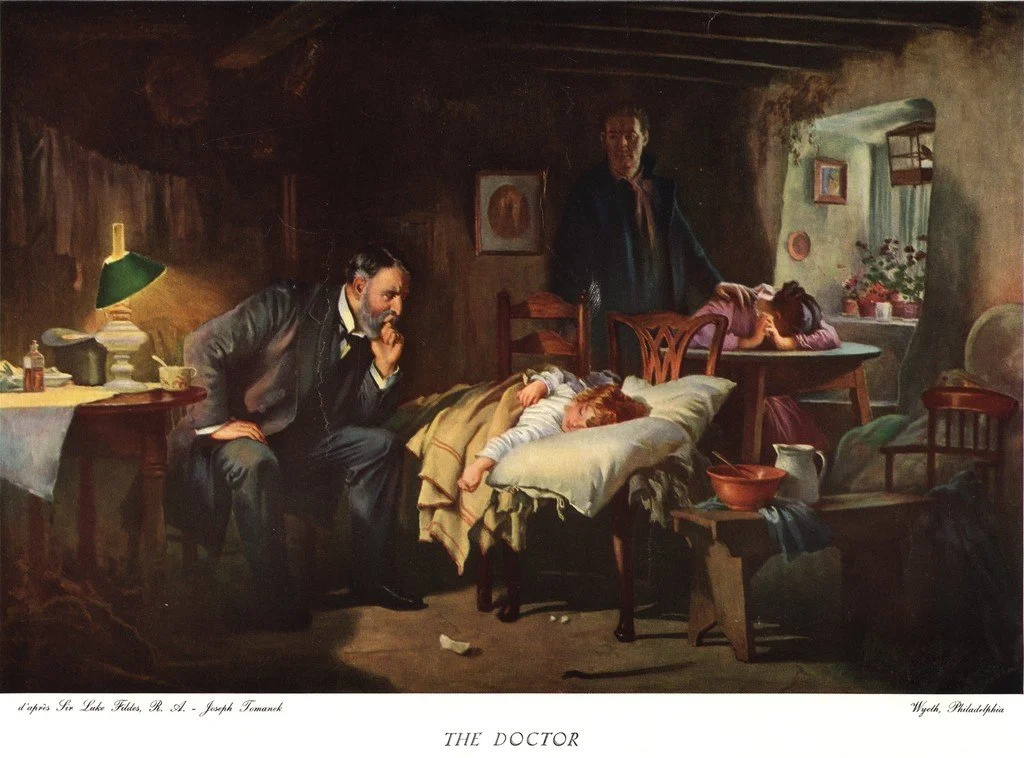
It is a print of an oil painting from 1891, by a Victorian artist named Sir Luke Fildes, called The Doctor.
I hung it there on purpose. And I want to tell you why.
A Scene From a Cottage
The painting shows a single moment, frozen in candlelight.
A physician sits at the bedside of a sick child in a humble cottage. The bed is improvised — two mismatched chairs pushed together. Behind him, the child's parents stand apart in shadow. The mother has collapsed forward in tears. The father stands with one hand on her shoulder, watching helplessly.
The doctor leans forward, chin propped on his hand, his furrowed brow turned toward the child. He is not doing anything. He is watching.
A pale band of light is just beginning to break through the cottage window. Dawn.
In Victorian medicine, dawn was the hinge. In the days before antibiotics, the "crisis" of a fever was the night the body either turned the corner or didn't. The doctor's job was to be there for the turning.
What Fildes Left Out
Look at the painting again. Look carefully.
There is no stethoscope. No microscope. No thermometer. No medical bag. By 1891, all of these instruments existed and were in common clinical use. Fildes knew that. He left them out anyway.
The only tools visible in the entire painting are a basin and a pitcher of water on a table beside the doctor — used to cool the child's fever.
Critics at the time noticed. As one essay in the Mayo Clinic Proceedings later put it, Fildes had reduced medicine to its "ancient fundamentals: observation and presence."
This was a deliberate artistic choice. And it is the reason the painting still matters.
The Story Behind the Painting
To understand why Fildes painted The Doctor the way he did, you have to know what happened to him fourteen years earlier.
On Christmas morning 1877, Luke Fildes lost his eldest son, Philip, to typhoid fever. The boy was one year old.
What stayed with Fildes was not the death itself, but the figure of the family doctor — a man named Gustavus Murray — who sat with them through the long nights of Philip's illness. Murray could not cure the boy. In 1877, no one could. What he could do was stay. And he did.
When Sir Henry Tate commissioned Fildes in 1890 to paint anything he liked for the new national gallery, this was the scene Fildes chose. Not a portrait of a saint. Not a triumph of science. A doctor at a bedside, doing what a doctor can do when there is nothing left to do.
The painting was hung in 1891. It became one of the most reproduced images in the history of medicine, and it still hangs in the Tate Britain in London today.
What the Painting Captures — and What We've Lost
The Victorian-era doctor in Fildes' painting was, in many ways, a limited figure. He had few tools, fewer cures, and no real ability to alter the trajectory of most serious illnesses. We would not trade modern medicine for his.
But he had something we have largely lost.
He knew the family. He had been to the house. He had time. He was present at the moments that mattered — the birth, the fever, the dying — and his presence itself was understood to be part of the care.
A British Medical Journal essay in 1892, the year after the painting was unveiled, wrote of it: "What do we not owe to Mr. Fildes for showing the world the typical doctor, as we would like to be shown — an honest man and a gentleman, doing his best to relieve suffering?"
Notice the phrase: as we would like to be shown. Even in 1892 — before HMOs, before insurance, before EHRs and prior authorizations and 8-minute visits — physicians already felt a gap between the doctor on Fildes' canvas and the doctor in the modern clinic.
That gap has widened. Considerably.
Why I Hung the Painting
I am not trying to practice 1891 medicine. I have a stethoscope. I have antibiotics. I have a smartphone that can pull a peer-reviewed article from anywhere in the world in three seconds. I am grateful for every one of these things, and so are my patients.
But the reason direct primary care exists — the reason I left a system I was good at, to build something smaller and stranger — is that modern medicine has slowly traded away the thing Fildes painted.
It traded presence for productivity. It traded continuity for coverage. It traded the doctor who knows you for whoever is available.
It did this for understandable reasons. Volume, billing, scale, technology, insurance contracts. None of these are villains. They are the rational outputs of a system optimizing for things that are not your relationship with your physician.
Direct care is the attempt to put that relationship back at the center. Not because we are nostalgic for the 19th century, but because something essential to healing was bundled up inside the bedside vigil — and when we lost it, we lost more than we realized.
How Did We Get Here
The painting in my exam room is the start of a longer story.
It is the story of how medicine moved from the cottage to the hospital, from observation to instrumentation, from the family doctor to the system. It is the story of antibiotics and CT scanners and electronic health records — extraordinary gains, real ones, that came with costs no one was tracking.
It is, ultimately, the story of how we got here. And how some of us are trying to find our way to something that takes the best of what medicine has become without leaving behind what it used to know.
I'm going to tell that story over the next five months on this blog. Each post will sit with one chapter — Victorian, early 20th century, mid-century, late 20th century, and where we stand today.
This is the first one. The doctor at the bedside. The painting on my wall.
If you've ever sat in a waiting room and felt like a stranger, or watched a loved one fall through the cracks of a fragmented system, or wondered whether medicine used to feel different than this — keep reading.
The dawn is just beginning to break through the window.
Sources & further reading:
Steensma DP, Kyle RA. "Luke Fildes and The Doctor." Mayo Clinic Proceedings, November 2019;94(11):e131–e132.
Moore J. "What Sir Luke Fildes' 1887 painting The Doctor can teach us about the practice of medicine today." British Journal of General Practice, March 2008;58(548):210–213.
Image Credit: The Doctor (1891). Artist: Sir Luke Fildes. Public domain. Source: World History Encyclopedia, https://www.worldhistory.org/image/17220/the-doctor/ .
Brian Bost, MD, MPH, is a Med-Peds physician and Physician-Founder of B2 Health Solutions and its clinical practice, B2 Direct Care — a hospitalist-informed, solo DpC micropractice in Denver, Colorado. The print of The Doctor that hangs in his exam room was the first thing he installed when the office opened in June 2026.