From Hearth to Hospital — How Medicine Moved Out of the Home
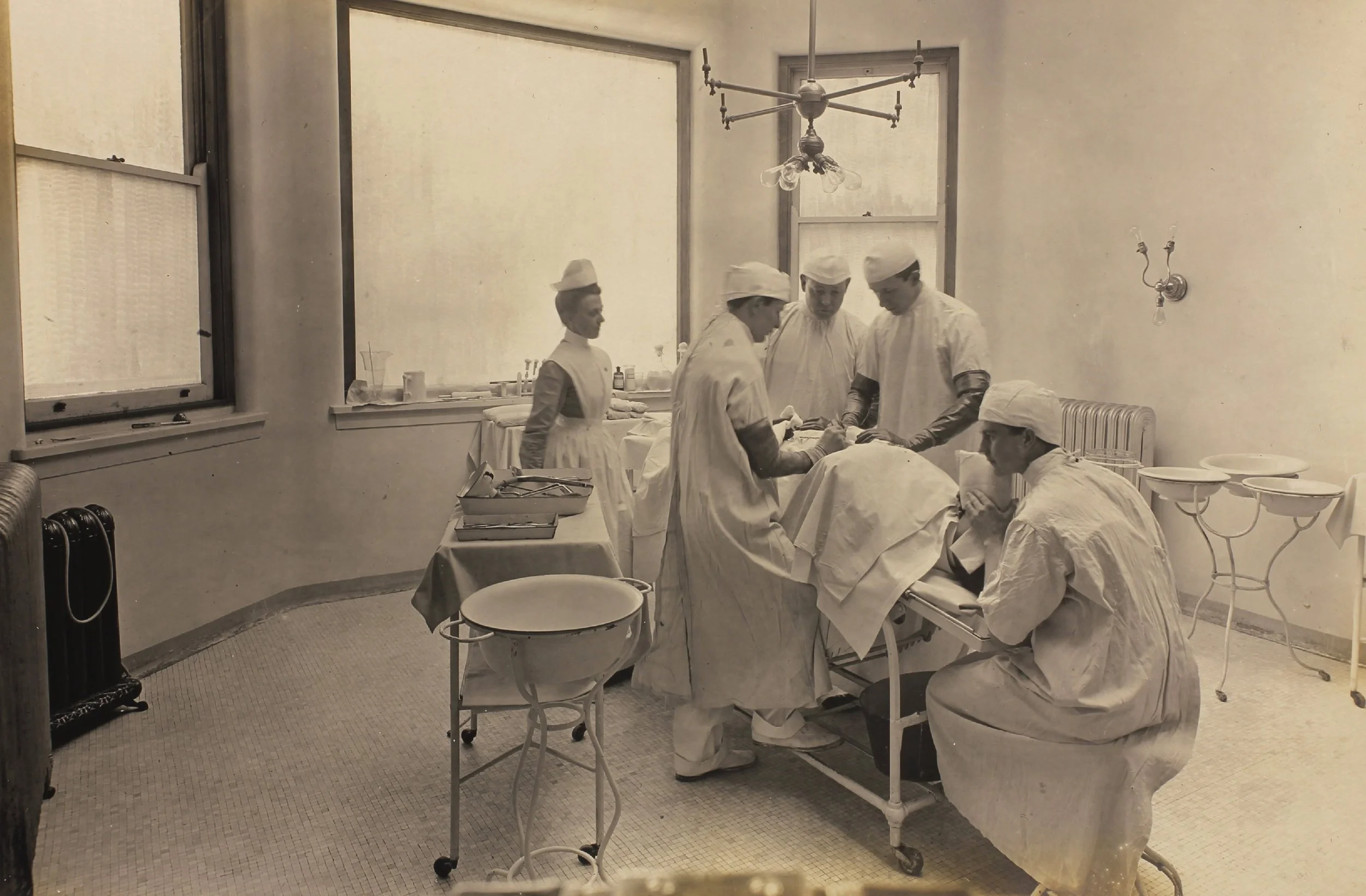
Within a single generation, the doctor stopped coming to your house. He started waiting for you in his. Here’s what we gained, and what we quietly lost.
If you grew up reading Little House on the Prairie, you remember when Doc Tan rode in on horseback to deliver Carrie, or dose a fever-stricken family with quinine, or sit at a sick child's bedside through the night. That image was not literary embellishment. For most of the 19th century — and well into the 20th — that is what a doctor was. Someone who came to you. Someone who sat at your kitchen table.
In Post 1 of this series, I wrote about Sir Luke Fildes’ painting The Doctor, which hangs in my exam room. The painting freezes a physician at the bedside of a sick child in a humble cottage. That scene was not nostalgic when Fildes painted it in 1891. It was current.
By 1925, it was not. By 1950, it was unrecognizable.
This post is about what happened in between.
The Hospital Used to Be Where You Went to Die
This sounds dramatic, but it’s true. For most of the 19th century, hospitals in America were charitable institutions, mostly serving the urban poor. If you had a home and a family, you stayed there to be sick. The hospital was where you went when you had nothing else.
Surgery was performed on kitchen tables. Babies were born in bedrooms. Pneumonia ran its course in your own bed, attended by your own doctor, who had also delivered you and would later deliver your children.
By the early 1900s, this began to change — fast.
Three things shifted in close succession: anesthesia became reliable, antisepsis was understood, and X-rays appeared. Suddenly the hospital wasn’t a charity refuge. It was where the new technology lived. If you wanted modern medicine, you had to go where the machines were.
The hospital stopped being a last resort. It became the destination.
The Flexner Report — A Turning Point
In 1910, a man named Abraham Flexner — not a physician — published a 364-page report on the state of American medical education. He had visited every medical school in the United States and Canada. What he found was chaos.
There were proprietary schools running out of rented rooms with no laboratories. There were “diploma mills” that conferred MDs in eighteen months for cash. There were eclectic schools, homeopathic schools, osteopathic schools, and a handful of legitimate university-based programs trying to compete with all of them.
Flexner recommended that American medicine consolidate around the German model: rigorous, science-based, university-affiliated, laboratory-driven. His report was funded by the Carnegie Foundation and backed by the AMA. Within a decade, more than half of America’s medical schools had closed.
The good news: medical training got dramatically better. Physicians who graduated after 1920 actually knew biochemistry and pathology and bacteriology. The science of medicine became real.
The cost was less visible at the time, but it was real too. The schools that closed disproportionately served women, Black students, and rural communities. The new biomedical model elevated the laboratory over the bedside, the specialist over the generalist, the hospital over the home. The doctor became, increasingly, a trained scientist — and trained scientists do not generally make house calls.
The Doctor Stops Coming to You
By the 1920s, house calls were already declining. By the 1940s, they were the exception. By the 1970s, they had largely vanished.
There were good reasons. The technology that helped patients lived in the hospital and the clinic. A doctor could see five or six patients in an office in the time it took to drive to one home. The expanding scope of medicine — radiology, lab medicine, electrocardiography — could not be carried in a bag.
But something was lost in the migration.
The doctor used to know your house. He knew which stairs creaked, which child was the quiet one, which grandmother lived in the back bedroom and had not been out of it in three years. He knew if you ate well, if your husband drank, if the roof leaked. None of that was in the chart. It was in his head, because he had been there.
The clinic could not replicate that. The clinic could only see what walked through the door.
The Rise of Institutional Authority
As medicine moved into the hospital, the doctor’s relationship to the patient changed shape too.
The 19th-century physician was a guest in your home. He was deferential to the family, even when he carried more knowledge than they did. The 20th-century physician was the authority in the institution. Patients deferred to him. They wore the gown he assigned. They waited in the room he chose. They were called by their last name while he was called Doctor.
This shift had a name: paternalism. For most of the 20th century, it was simply assumed that the doctor knew best, that the patient need not be fully informed, that consent could be a formality. The phrase “informed consent” did not enter American law in any serious way until the 1970s.
We have largely corrected this. Modern medicine is far more collaborative than it was in 1930. But the architecture of the hospital — its waiting rooms, its gowns, its schedules built around the physician’s day rather than the patient’s — is still with us. The doctor is still the host of the encounter. The patient is still the guest.
Why This Matters Now
I am not arguing we should go back to 1891. The hospital, properly used, saves lives that the cottage never could. I work in a hospital. I am grateful for what it can do.
But the early 20th century is when we first started trading something away without fully naming the trade. We exchanged the doctor who knew your house for the doctor who had the equipment. We exchanged continuity for capability. We exchanged the bedside for the office.
For a while, the trade looked unambiguous. The capability gain was enormous. The continuity loss was hard to measure.
A century later, the loss is easier to see. Patients who don’t have a primary care doctor. Patients who have one but can’t get an appointment. Patients who are referred to a specialist who doesn’t know them and doesn’t have time to.
Direct primary care is, in part, an attempt to bring back the part of the bargain that got lost. Not the kitchen-table surgery. Not the horse-and-buggy house call. But the part where one physician knows you, has time for you, and is reachable when you need them.
Next in the Arc
In Post 3, we'll move into the mid-20th century — the Golden Age of Antibiotics, the rise of specialization, the birth of Medicare and Medicaid, and the moment when medicine became, unmistakably, an industry.
If you missed Post 1 — The Doctor: Why an 1891 Painting Hangs in My Exam Room — start there.
Sources & further reading:
Flexner A. Medical Education in the United States and Canada: A Report to the Carnegie Foundation for the Advancement of Teaching. Bulletin No. 4. New York: Carnegie Foundation, 1910.
Starr P. The Social Transformation of American Medicine. New York: Basic Books, 1982. (The definitive history of how American medicine became what it is — readable and essential.)
Image Credit: Operating Room, Stobhill General Hospital, Glasgow (1911). Public domain photograph. Source: Wisconsin Historical Society, https://wisconsinhistory.org/Records/Image/IM24246.
Brian Bost, MD, MPH, is a Med-Peds physician and Physician-Founder of B2 Health Solutions and its clinical practice, B2 Direct Care — a hospitalist-informed, solo DpC micropractice in Denver, Colorado. This is Post 2 of the How Did We Get Here series.