The Golden Age — How Antibiotics Saved Lives and Built an Industry
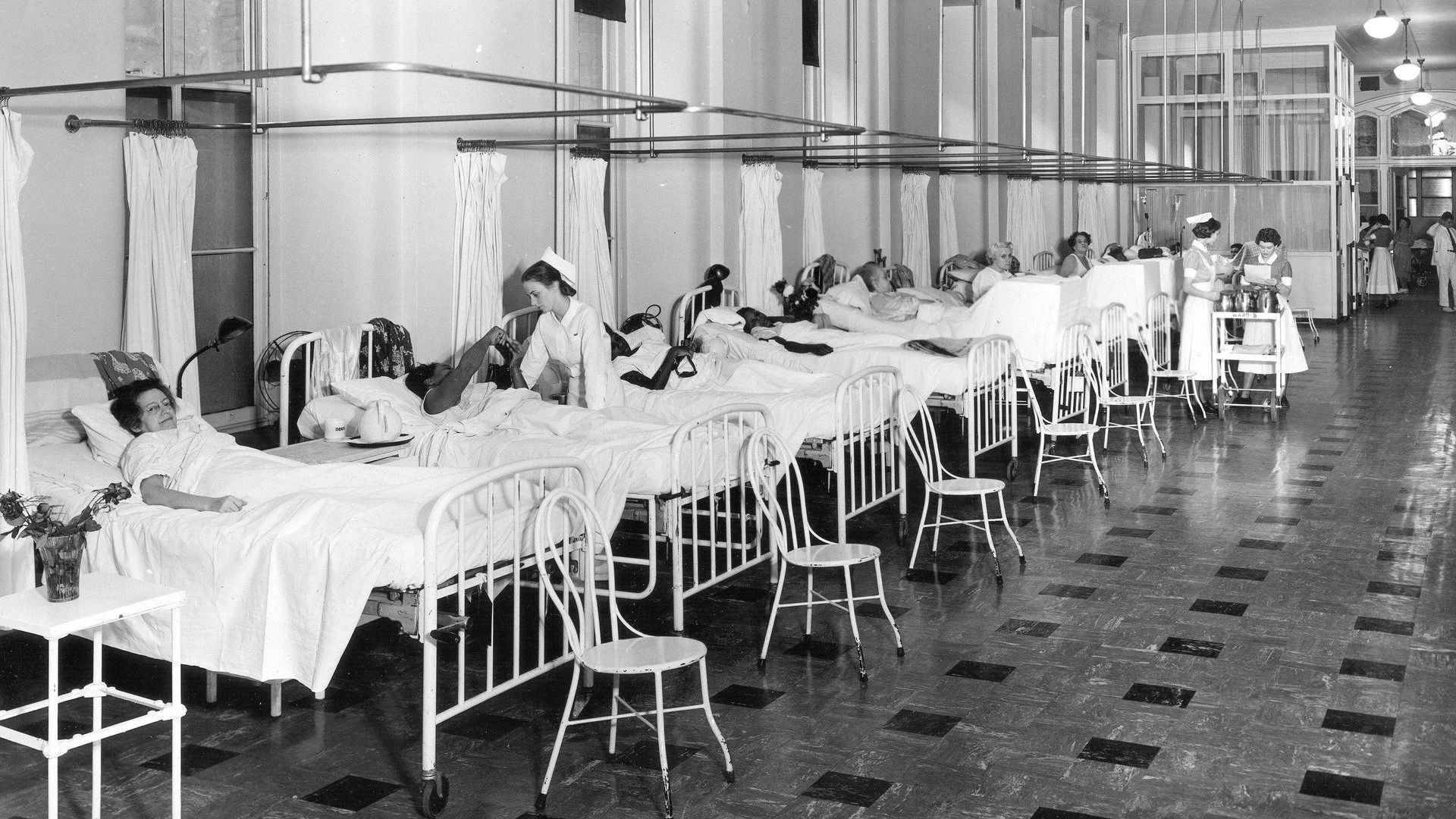
Between 1940 and 1965, medicine learned to cure things it had previously only watched. It also became, for the first time in American history, an industry. Both things happened at the same time. Neither is reversible.
If you had a bacterial infection in 1935, your doctor watched you. If you had one in 1955, your doctor cured you.
That sentence summarizes maybe the most profound change in the history of medicine. It is impossible to overstate how completely antibiotics rewrote what a physician could do for a sick person. Diseases that had killed for millennia — pneumonia, scarlet fever, syphilis, puerperal sepsis, strep throat — became, within roughly fifteen years, problems with prescriptions.
The patient survived. The doctor became a hero.
And in the same span, medicine quietly turned into something it had never been before: a multi-billion-dollar industry with corporate logic, specialist hierarchies, and an insurance apparatus built around it.
This is the story of how those two things happened together. Because they did. And we have not yet untangled them.
The Golden Age of Antibiotics
Alexander Fleming famously discovered penicillin in 1928 — a mold on a forgotten Petri dish in his London lab. For a decade it was a curiosity. The drug could not be produced in quantity or purified for human use.
The Second World War changed that. The U.S. War Production Board partnered with pharmaceutical companies — Merck, Pfizer, Squibb, Lilly — to scale penicillin production for the troops. By D-Day in 1944, there was enough penicillin to treat every Allied casualty who needed it. By 1945, it was available to civilians.
What followed has been called the Golden Age of Antibiotics. Between 1940 and the mid-1960s, every major class of antibiotics we still use today was discovered: penicillins, streptomycin, tetracyclines, macrolides, cephalosporins. Tuberculosis became treatable. Postpartum infection stopped killing young mothers. Childhood ear infections stopped causing deafness.
For physicians, the experience must have been astonishing. To watch a patient be dying of pneumonia, give an injection, and watch them sit up the next day — a generation of doctors lived through that. They had been trained, like Fildes' doctor, to sit and watch and stay. They were suddenly able to cure. The profession's self-image changed accordingly.
The Specialist Era
As medicine became more capable, it also became more complex. No single physician could keep up with what was now possible in cardiology, oncology, neurology, endocrinology, infectious disease, surgery, radiology, and on and on.
The specialist emerged as the dominant figure of postwar American medicine. Between 1940 and 1970, the proportion of American physicians who described themselves as generalists fell from roughly 75% to less than 20%. The most prestigious training programs were not in general practice. They were in subspecialty fellowships at academic medical centers.
The result was a system that could do extraordinary things — but only if you could navigate it. Your heart belonged to one doctor, your kidneys to another, your skin to a third, and your overall coherence as a human being belonged, increasingly, to nobody.
The family doctor — the one who knew you, your spouse, your kids, and your grandmother — became a kind of ghost figure. Honored in retirement speeches. Less and less reimbursed in actual practice.
The Birth of the Insurance Apparatus
Health insurance as we know it is largely a postwar invention.
Before the 1940s, most Americans paid their doctor directly, in cash or in trade. Hospital bills, when they existed, were usually negotiable. Insurance was mostly for catastrophic events.
That changed for two reasons. During World War II, wage controls prevented employers from competing for scarce labor with higher salaries — so they competed with benefits. Health insurance was one. The IRS then declared employer-sponsored health insurance tax-exempt, which locked the practice in. By the late 1950s, employer-based insurance was the dominant way Americans paid for care.
Then, in 1965, Lyndon Johnson signed Medicare and Medicaid into law. The federal government suddenly became the largest single payer in American medicine. The reimbursement structures that came with those programs — the codes, the documentation requirements, the audit framework — shaped how every American physician would practice for the next sixty years, regardless of whether their patients were on Medicare or not.
This was the moment when the doctor-patient encounter stopped being a two-party transaction. From that point on, a third party — the insurer, the government, the employer — was always in the room.
A Note on Fildes' Painting
There is a small and revealing footnote here. In 1947, the American Medical Association — facing a serious push by the Truman administration to nationalize American healthcare — needed an image for their campaign. They chose Sir Luke Fildes' The Doctor.
Posters and pamphlets went up in physician offices across the country with reproductions of the painting and a caption: "Keep Politics Out of This Picture." The argument was that the intimate doctor-patient relationship Fildes had captured would be destroyed by government intrusion.
The campaign worked. National health insurance died in Congress in 1949. The painting, in retrospect, was being used in a fight whose terms were already obsolete — the medicine of 1948 looked very little like the cottage scene of 1891, and what was about to come would look even less like it.
But it tells you how much weight that painting was already carrying. Even then, even from people whose actual practice had largely abandoned the bedside, The Doctor was the image medicine reached for when it wanted to defend itself.
Two Things at Once
The mid-20th century is the hinge of this whole arc.
In a single generation, medicine became wildly more effective than it had ever been — and simultaneously became something whose primary structural logic was no longer the doctor-patient relationship. It was the institution, the insurer, the specialist hierarchy, the billing code.
Patients lived longer. They were also, in some new way, more alone in the system. Doctors saved more lives. They also, in some new way, knew their patients less.
We tend to talk about this as a recent problem — burnout, EHR documentation, prior authorizations. It is not recent. The architecture was laid down between 1945 and 1965. We have been living inside it ever since. Direct care is one attempt to step back outside it — to take the third party out of the exam room and give the whole picture back to one physician.
Next in the Arc
In Post 4, we'll move into the late 20th century — when the gains kept coming, the costs became impossible to ignore, and a generation of physicians started to wonder whether the system they had trained for was still the one they wanted to practice in.
If you're new to the series: The Doctor (Post 1) is the painting. From Hearth to Hospital (Post 2) is how medicine left the home. This post is how it became an industry. The next is where it broke.
Sources & further reading:
Bud R. Penicillin: Triumph and Tragedy. Oxford: Oxford University Press, 2007.
Starr P. The Social Transformation of American Medicine. New York: Basic Books, 1982.
Steensma DP, Kyle RA. "Luke Fildes and The Doctor." Mayo Clinic Proceedings, November 2019;94(11):e131–e132. (For the 1947 AMA campaign reference.)
Image Credit: Quaker Photo Service Co., photographer. Hospital of the University of Pennsylvania, Interior, Ward. photograph, ca. 1950. UPX 12, University Photograph Collection, Box 27, folder 15, JSTOR, https://jstor.org/stable/community.22109037. Accessed 13 Sept. 2025.
Brian Bost, MD, MPH, is a Med-Peds physician and Physician-Founder of B2 Health Solutions and its clinical practice, B2 Direct Care — a hospitalist-informed, solo DpC micropractice in Denver, Colorado. This is Post 3 of the How Did We Get Here series.